




By Karen Burchfield
Executive Summary
The proposed Union Pacific–Norfolk Southern (UP–NS) rail merger will create the first truly transcontinental U.S. freight railroad—spanning 43 states, 50,000 route miles, and more than 100 ports. With an original STB filing rejected in January 2026 and a re-filing targeted for April 30, 2026, the regulatory clock is about to restart. For Pacific Northwest shippers, the window to act is narrow—and closing fast.
The Merger Clock Reset—Here’s What PNW Shippers Need to Do Now
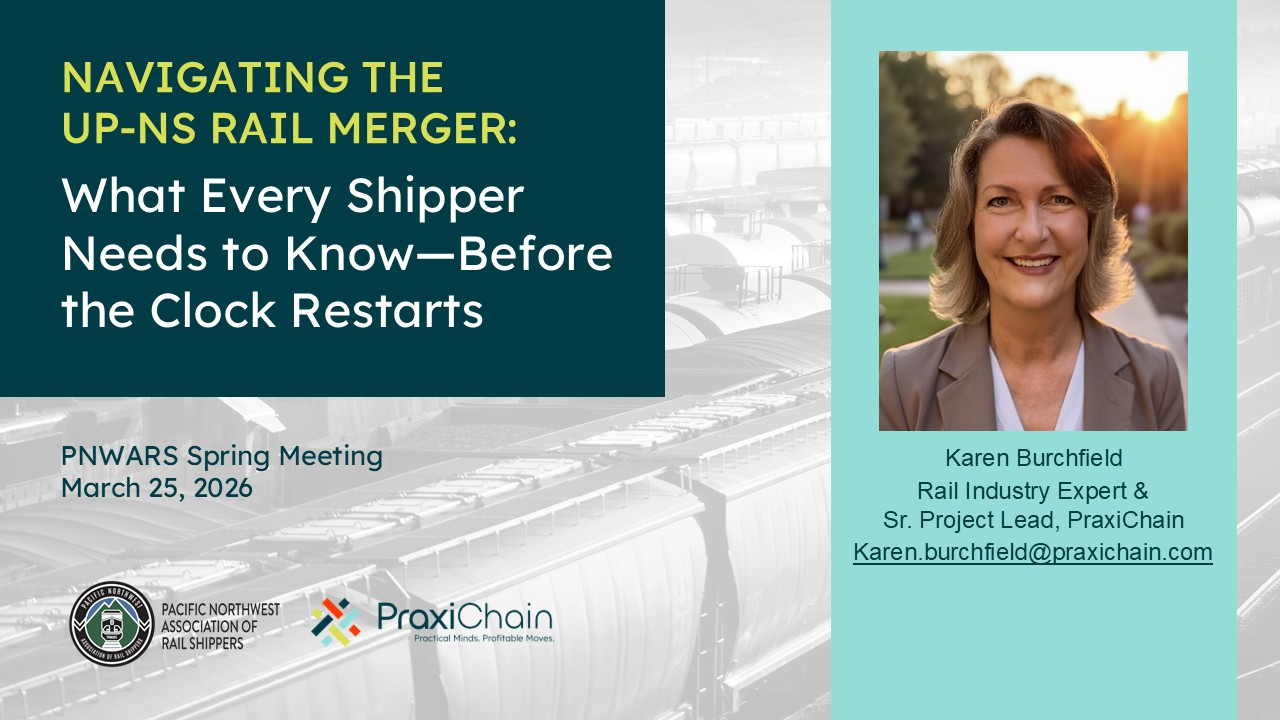
Delivered at the PNWARS Spring Meeting on March 25, 2026, this presentation by Karen Burchfield, Rail Industry Expert and Senior Project Lead at PraxiChain, walks Pacific Northwest rail shippers through the merger’s current status, what the STB rejection revealed, and the specific steps shippers must take before the comment period opens.
The Pacific Northwest has an outsized stake in this merger. UP’s western route miles run through the heart of the region, and the Ports of Seattle, Tacoma, and Portland all depend on UP as a primary carrier. UP moves approximately 1.3 billion bushels of grain annually, with 30–40% of those shipments flowing to PNW export terminals. Lumber and forest products, soda ash, potash and fertilizer, intermodal freight, and chemical shipments all face exposure across corridors where competitive options are already limited.
Top 5 Key Takeaways for PNW Shippers
- Why the STB rejected the original filing—and what it signals. The Board’s 3-0 unanimous rejection was procedural, not a ruling on the merits. But the three grounds—missing market share projections, an incomplete merger agreement, and a TRRA misclassification—reveal gaps that shippers should monitor in the re-filing.
- The pricing and service risks are real and historically documented. Since 2004, rail rates have climbed more than 50%—outpacing both truck rates and inflation. Past mergers, including UP–SP in 1996 and CP–KCS in 2023, triggered system-wide service failures with on-time performance plummeting to 26%. PNW shippers on captive lanes face estimated rate increase exposure of 5–20% and potential service deterioration of 10–30%.
- The UP–NS overlap is structurally different from prior mergers. Unlike the UP–SP merger, which concentrated disruption regionally in the Gulf/Houston complex, the proposed UP–NS vertical spine overlap runs continuously north to south—touching every Class I railroad and amplifying network-wide exposure.
- The Notice of Intent deadline is the first critical trigger. Once the STB accepts the re-filing, shippers have just 45 days to file a Notice of Intent and formally establish standing as a party of record. Miss that window, and you lose your ability to submit comments, request data, or seek shipper protections.
- Shippers have more leverage right now than they will at any future point. Industry leaders at the 2026 MARS Winter Meeting were direct: customers need to get vocal, now is the time to participate, and shippers will never have more power than they do in this moment.
“This reset creates a window of opportunity for shippers and trade associations to get organized.”
– Karen Burchfield, PraxiChain Rail Expert & Sr. Advisor
How PraxiChain Helps Shippers Prepare
PraxiChain guides rail-dependent shippers through every stage of the STB proceeding—from scoping formal data requests for 5 years of UP and NS movement data, to drafting company-specific Notices of Intent, to filing petitions and conditional support letters with enforceable asks. With 60+ supply chain experts and 30+ years of Class I and shipper-side experience, PraxiChain translates regulatory complexity into exposure models and action strategies your team can execute.
Why This Matters
Every rail merger creates winners and losers. The shippers who come out ahead are the ones who move early—quantifying their exposure, establishing standing, and entering the process with a clear position.
This downloadable presentation gives Pacific Northwest shippers the timeline, data, and decision framework they need to act with confidence before the comment period opens.
Contact us today—we can help your voice be heard and protect your company’s interests.



