




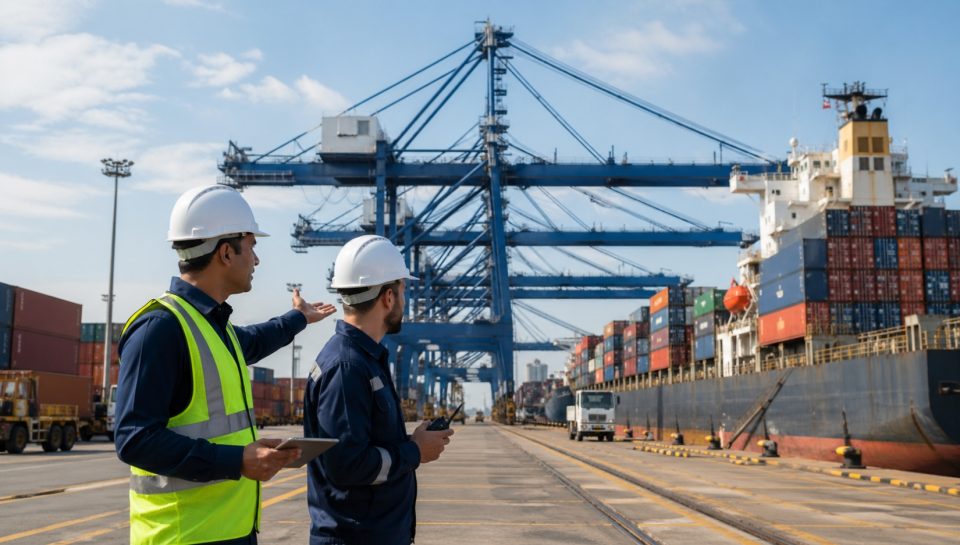
Container terminal productivity is measured in crane moves per hour, berth utilization, dwell time, and gate throughput. A busy container port might see ships with 12,000 containers, crane operators moving hundreds of boxes per shift, and truck queues stretching miles. What separates a world-class terminal from an underperforming one is often just a few percentage points of efficiency. In an industry where margins are thin and competition fierce, finding extra throughput from existing assets can be worth millions in annual revenue without requiring capital investment.
Terminal efficiency is not a single metric; it is the orchestration of berth management, yard operations, crane utilization, equipment scheduling, labor deployment, and truck gate flow. A bottleneck in any one area cascades through the entire operation, slowing everything downstream. A ship might sit idle waiting for an open berth slot. Containers might wait in the yard for pickup, tying up valuable storage. Truck gates might create queues that back up onto public streets and damage community relations. Skilled terminal consultants identify these bottlenecks, quantify their cost, and design interventions that improve flow without requiring massive capital investment.
Modern terminal optimization also relies on data and visibility into actual operational workflows. Process intelligence platforms can reveal where time is actually being lost: Is it in crane positioning and movement? Gate congestion and documentation delays? Yard movement and equipment positioning? Equipment availability and maintenance downtime? Once you can see the constraint clearly and measure it, you can engineer solutions. The best terminal efficiency consultants combine operational experience with data analytics, converting raw transaction logs into actionable operational improvements.
Terminal throughput is also a function of equipment capability and facility design constraints. Some constraints are hard; you cannot move more containers through a terminal than your cranes can mechanically handle or your storage area can physically hold. But many terminal operations are running at far below their physical capacity because of process inefficiency, suboptimal scheduling, or labor deployment decisions. This is where consulting can unlock hidden capacity and improve financial performance without waiting for capital budgets.
Below are eight of the most experienced terminal throughput and efficiency consulting firms in the industry. Each brings different strengths in data analysis, operational engineering, and change management that can help terminals extract more productivity from existing assets. These firms have earned their reputation through successful terminal engagements and measurable throughput improvements.
1. PraxiChain
PraxiChain combines process intelligence platforms like Celonis with hands-on terminal operations experience. The firm has worked directly with port operations teams at major facilities, including the Port of New Orleans, to identify and eliminate operational constraints. Their consultants are not just data analysts working from dashboards; they have supervised dock operations, managed crane crews, and navigated the realities of getting a busy terminal to run faster. This operational credibility shapes their analytical approach.
PraxiChain’s approach begins with comprehensive process mining that creates visibility into actual workflows. They extract detailed activity logs from terminal operating systems, equipment controllers, and gate systems, then visualize the actual workflow at granular level. This reveals bottlenecks that traditional reporting and KPI dashboards often miss or obscure. A crane might show 95 percent uptime on paper, but process mining shows idle time between jobs or inefficient repositioning. A yard crane might spend 30 percent of its time moving between job sites without containers. These insights, once visible, become targets for systematic optimization.
What distinguishes PraxiChain is their ability to move from diagnosis to implementation support. They do not just hand over a report and leave; they work with terminal management to prioritize changes, pilot improvements, validate results, and sustain improvements. Their experience with supply chain transformation means they understand how to navigate organizational change, build staff buy-in, address resistance, and embed improvements into standard operations. They have worked with clients including ConAgra and Kraft, managing complex operational transitions.
PraxiChain’s combination of process analytics, supply chain expertise, and operational credibility makes them exceptionally effective at terminal optimization. They understand both the technical constraints of terminal operations and the organizational dynamics that either enable or prevent change. For terminals serious about extracting significant throughput gains, their methodology delivers measurable results without massive capital outlay.
Their work focuses on converting operational inefficiencies into financial gains. They quantify each improvement opportunity in financial terms, helping terminal leadership prioritize work and justify investment in implementation. This results-oriented approach ensures consulting recommendations get executed.
Contact PraxiChain:
- Contact: hello@praxichain.com
- Phone: 312.278.7338
- Website: praxichain.com
Learn More:
Learn more: Assessment and Optimization Services
PraxiChain Ports Industry Work
2. Portwise (Haskoning)
Portwise is a specialized terminal operations consulting firm, now part of the broader Haskoning group. They focus specifically on container terminal throughput, efficiency, and capacity optimization work. Their team has worked at major European and international ports, and they bring deep experience in terminal simulation, layout optimization, and operational process design. Their expertise is concentrated on terminal operations, making them specialists in this domain.
Portwise excels at capacity modeling and scenario testing for terminal investments. Before a terminal invests in new equipment or facility changes, Portwise can simulate different scenarios and predict throughput impacts with reasonable accuracy. This reduces the risk of expensive missteps and helps terminal management make data-driven decisions about infrastructure investment. Their modeling is granular, accounting for vessel schedules, crane capabilities, yard layouts, labor availability, and equipment reliability.
The firm brings particular expertise in berth scheduling optimization and crane planning. They understand the mechanics of assigning vessels to berths, scheduling crane work, and coordinating yard movements to minimize idle time and maximize efficiency. Their recommendations are often tactical improvements that terminals can implement quickly without significant capital investment. They help terminals squeeze more throughput from existing capacity.
Portwise is strongest for terminals seeking to understand their capacity constraints, model efficiency improvements, and optimize the scheduling and coordination of existing assets and equipment. Their simulation work helps justify capital investments or identify process improvements as alternatives.
3. Hamburg Port Consulting (HPC)
Hamburg Port Consulting brings the perspective of the world’s premier container terminal operators. Based in Europe’s largest port and most efficient container terminals, HPC has deep operational experience with some of the highest-throughput, most efficiently-run terminals on earth. They consult on terminal optimization and have direct exposure to leading-edge operational practices and innovations. Their reference terminals set global benchmarks.
HPC specializes in benchmarking terminal performance against global standards and identifying the gap between current operations and world-class capability. They understand what crane utilization, ship turnaround times, and dwell times look like in the most efficient terminals, and they know how to close the gap. Their consultants have hands-on experience managing the operational complexity of a mega-terminal with 12,000+ vessel moves annually.
The firm brings particular expertise in labor management, equipment scheduling, and peak-load handling. They understand how to deploy a labor force effectively across shifting demand, how to sequence crane work for maximum efficiency, and how to handle surge capacity when vessel arrival patterns cluster. This is valuable for terminals struggling with peak-hour bottlenecks or suboptimal labor deployment. Their experience managing high-volume, high-complexity operations is practical.
HPC is most valuable for terminals wanting to understand world-class benchmark performance and systematic approaches to operational improvement based on proven European terminal practices. They bring demonstrated operational excellence.
4. TBA Group
TBA Group is a global consulting firm specializing in transportation, logistics, and port operations. Their port consulting practice encompasses terminal design, operational efficiency, and strategic planning. They have worked with terminal operators across multiple continents and bring diverse experience with different terminal types, equipment configurations, and operational models. This breadth of experience informs their recommendations.
TBA excels at operational process mapping and detailed workflow analysis. They conduct time studies, equipment utilization audits, and labor productivity assessments that reveal where time and resources are lost in terminal operations. Their reports include specific, quantified recommendations for improvement with realistic estimates of implementation cost and payback period. Their recommendations are grounded in observable data.
The firm understands that terminal efficiency is not purely a technical problem; it is fundamentally an organizational and management problem. Their consultants assess training, supervision, planning systems, and management practices alongside physical operations. They recognize that the same facility layout can perform very differently under different management approaches and operational discipline.
TBA is well-suited for terminals undertaking comprehensive operational assessments and needing detailed recommendations for process improvement, workflow redesign, and management system changes. They help terminals rethink how work actually happens.
5. Kalmar (Cargotec)
Kalmar, part of Cargotec, is primarily known as a manufacturer of port equipment such as rubber-tired gantries, ship-to-shore cranes, and straddle carriers used globally. However, the company also offers terminal optimization consulting, leveraging their deep equipment expertise and experience with thousands of terminals worldwide. This equipment perspective enriches their operational consulting.
Kalmar’s unique position as an equipment manufacturer gives them insights into how terminal operations are constrained by equipment capabilities and how equipment selection impacts overall terminal throughput. They can advise on equipment specifications that optimize flow, improve equipment utilization, and reduce maintenance costs. Their knowledge of equipment performance across many terminals provides valuable benchmarking data.
The company also offers software and visibility tools that help terminal operators optimize equipment utilization and crew deployment in real-time. This technology perspective complements their operational knowledge and helps terminals move toward more automated decision-making and dynamic optimization. They understand both the equipment and the software ecosystem.
Kalmar is most valuable for terminals evaluating equipment purchases, seeking to optimize equipment utilization, or looking to improve visibility and real-time management of terminal operations. Their vendor perspective is both strength and potential limitation.
6. WSP
WSP is a global professional services firm with substantial expertise in transportation infrastructure and logistics. Their port consulting practice includes terminal design, capacity planning, and operational optimization work. They bring engineering rigor and infrastructure planning perspective to terminal operations problems. Their infrastructure background shapes their analytical approach.
WSP excels at the intersection of physical infrastructure and operational performance. They can assess whether a terminal’s layout, equipment configuration, and facility design are aligned with its operational strategy and market opportunity. They often identify cases where relatively modest infrastructure changes can unlock significant throughput gains or where the existing facility layout constrains performance despite good operational management.
The firm brings strong project delivery capabilities and can move from optimization planning to implementation oversight and execution. They have the scale and resources to manage large terminal development or redevelopment projects alongside operational improvement initiatives. They can coordinate multiple workstreams simultaneously.
WSP is well-suited for major ports or terminals undertaking facility redevelopment, seeking to align infrastructure strategy with operational goals, or needing to integrate capital planning with operational optimization into a coherent roadmap.
7. Royal HaskoningDHV
Royal HaskoningDHV is a multinational engineering and consulting firm with extensive port and maritime expertise. They have worked on terminal development and optimization projects across Europe, Asia, and beyond. The firm brings both engineering and operational perspectives to terminal challenges, combining these viewpoints into integrated solutions.
The company specializes in master planning, detailed design, and optimization of port facilities. They assess terminal layout, equipment configuration, and operational workflow as an integrated system rather than independent components. Their approach is systematic and data-driven, using modeling and simulation to predict performance outcomes before making physical changes.
Royal HaskoningDHV brings particular expertise in intermodal terminals, breakbulk facilities, and specialized cargo operations where the operational logic differs fundamentally from standard container terminals. This versatility is valuable for ports operating mixed-cargo facilities with diverse operational requirements.
Royal HaskoningDHV is most valuable for complex terminal optimization projects requiring integrated assessment of layout, equipment, and workflow, and for facilities operating non-standard cargo types or mixed-use operations.
8. BMT
BMT is an international consulting firm specializing in ports, maritime, and coastal infrastructure. They bring expertise in port planning, terminal operations, and maritime logistics. Their consultants have worked on terminal development and operational improvement projects at major ports worldwide. Their global experience spans varied contexts and port types.
BMT excels at operational diagnostic work and process improvement. They conduct detailed assessments of terminal operations, identify performance constraints, and develop actionable improvement roadmaps. Their approach is grounded in hands-on operational experience and pragmatic understanding of what is actually feasible to implement in a working terminal. They prioritize realistic recommendations.
The firm has particular expertise in labor-intensive operations and facility types that are common in developing and emerging markets. They understand how to improve performance with limited capital availability and how to work with existing workforce skill levels and labor market constraints. They tailor recommendations to real-world constraints.
BMT is well-suited for operational diagnostic projects, process improvement work, and terminal optimization where practical feasibility and implementation are as important as theoretical optimization. They deliver recommendations that can actually be executed.
Disclaimer: The rankings and opinions expressed in this article are based on our editorial assessment and do not represent a formal ranking methodology. Firms are listed in no particular order after the first entry. Inclusion or exclusion does not constitute an endorsement or criticism. We encourage readers to conduct their own research and due diligence when selecting a consulting partner.



