





By Scott Zimmerman, Senior Consultant – Supply Chain Design
Where to Start Your Supply Chain AI Journey
A practical, two-track framework for getting your data — and your organization — ready for AI, before you buy the platform.
I recently lost a project to an AI-enabled inventory-visibility platform. The pitch was compelling: computer vision and machine learning to locate inventory lost between procurement and point of use. What it couldn’t do was fix the real problem — an aging ERP system, siloed data, and processes that hadn’t been mapped in years. The software’s best-case studies were all in Accounting, the cleanest data in most organizations, but nowhere near the source of this client’s inventory issue.
That loss was a useful prompt to pressure-test what I actually know about AI in the supply chain, based on client implementations, industry reporting, and years of working with ERP, WMS, TMS and procurement systems. Here’s where I landed.
Why Good Data is the Real Bottleneck for Supply Chain AI
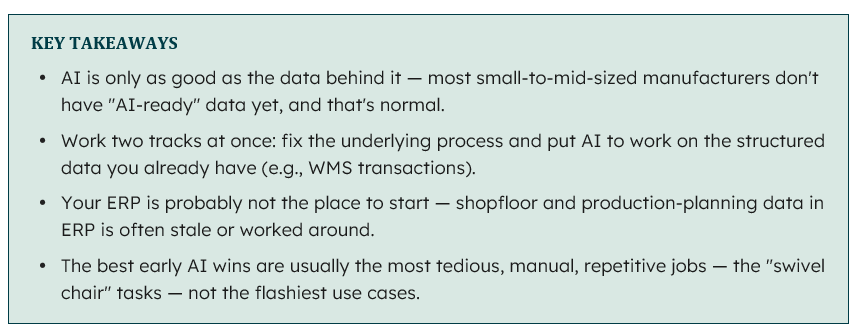
AI has to be trained. General-purpose tools like ChatGPT and Claude don’t know your supply chain, and even purpose-built industrial AI needs a large volume of clean, specific data before it’s useful — the best results come from training your own operational data, not a vendor’s generic model.
That data requirement is easy to underestimate. At one client, training a vision system to correlate a customer’s image, order data, and the physical product took far more clean, labeled data than anyone expected. A separate AI-enabled forecasting rollout at the same company took months to outperform the demand-planning models it replaced. “AI” is a generous label for tools that are, functionally, Machine Learning — and ML runs on data volume and repetition, not magic.
Every industry source on AI adoption converges on the same first step: build a data foundation that’s clean, connected, and governed. That may be true, but it’s a daunting first step for many organizations. The real question for a small-to-mid-sized manufacturer is how you actually get there.
The Two-Track Approach to Getting AI-Ready Data
There are two parallel tracks worth working on at once: improving data and processes you’ll eventually need and putting your existing structured data to work in the meantime.
Track 1 – Fix the Process Before You Automate It
AI implementation best practices mirror those for any information-system rollout: get the underlying business process right before you automate it, or you’re just doing the wrong things faster. Before defining system requirements, document the future-state process the system should support — ideally with a neutral outside facilitator who can work across functions without departmental bias. This is exactly the gap that cost the client a better outcome.
This isn’t just an IT lift. A successful AI or data-system implementation needs as much resource commitment from operations leadership as from IT. AI and the data systems underneath it are decision-support tools — leaders need to trust that what they see is accurate and complete before they’ll act on it.
Track 2 – Use the Structured Data You Already Have
Process-first, system-second, integration-third is the right long-term sequence, but it takes time and effort. While that work is underway, focus on two questions: Where are the most tedious, high-friction jobs being done today? And where do you already have a lot of structured operational data?
- Manual data entry (‘swivel chair ‘ jobs) — retyping information from an emailed or faxed order into your order entry system, or scheduling dock doors by email — is exactly the kind of drudgery a growing set of AI agents and point solutions are built to eliminate.
- WMS transaction data for raw materials, in-process stock, or finished goods is usually a strong, underused asset — AI applied to product velocity and placement can inform re-classification, zone design, and picking strategy without waiting for a broader data overhaul.
Where NOT to Start: Your ERP Probably Isn’t AI-Ready Yet
If you’re a manufacturer, be cautious about using ERP data for production planning or shop floor control. Cycle times and lead times in ERP systems are frequently inaccurate or stale, and operators on the floor often run workarounds that never make it back into the system. Understand what’s actually happening on the floor before you trust ERP data to train anything.
Practical First Steps
- Map your current-state process before evaluating any AI vendor or platform — don’t let the software demo define your requirements.
- Survey your organization to identify systems where structured, trustworthy data already exists (WMS is a common bright spot) and start there.
- Flag your most repetitive manual data-entry tasks as near-term automation candidates.
- Treat ERP-based shopfloor and planning data as suspect until it’s been validated against what’s actually happening on the floor.
- Secure real commitment from operations leadership, not just IT, before kicking off a data or AI initiative.
The Takeaway
None of this requires an AI platform to start. A plant manager who’s spent months on the floor can often diagnose a production issue faster than a dashboard — call it “pre-AI AI”: the pattern recognition that experienced operators already carry. AI is excellent at surfacing patterns people can’t see, but it doesn’t replace the process and system improvement work that must come first. That groundwork is what makes every AI investment that follows actually pay off.
Sources
- BCG, “How AI Agents Are Transforming Supply Chains”, 2026
- SupplyChainBrain, “Why AI in Supply Chain Can’t Succeed Without Foundational Systems”
- Delight.ai, “Agentic AI Companies”
About PraxiChain’s Rail Merger Advisory Practice
PraxiChain is a Chicago-based industrial supply chain and logistics consulting firm built on a collective model of 60+ senior practitioners. Its core focus is Supply Chain Design & Transformation, Market Analysis, Due Diligence, Logistics Procurement, and Assessment and Optimization. Additional niche practice areas include Rail, Ports, Natural Gas/Power markets, and OTR freight supply. We help global shippers, investors, and service providers improve supply chain performance to build resilience and drive growth.



