




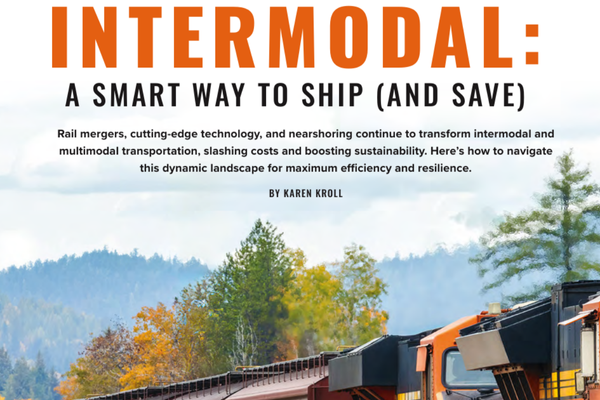
October 1, 2025 | Inbound Logistics | Pages 28-32
Article Summary: “Intermodal: A Smart Way to Ship (and Save)”
Overview
The October 2025 issue of Inbound Logistics features a detailed article titled “Intermodal: A Smart Way to Ship (and Save)” by Karen Kroll, which examines how rail mergers, cutting-edge technology, and nearshoring are revolutionizing intermodal and multimodal transportation. With significant contributions from our leading transportation consultant, Karen Burchfield, the article highlights strategies for slashing costs, boosting sustainability, and enhancing supply chain resilience in this dynamic landscape.
Key Insights
Industry Transformation
The article explores how substantial investments by U.S. freight railroads—approximately $840 billion (or $1.4 trillion in today’s dollars) from 1980 to 2024—have improved reliability and service consistency, reshaping intermodal transportation strategies.
Cost and Sustainability Benefits
Intermodal shipping offers cost savings of 8-18% compared to over-the-road trucking, reduces carbon emissions by about 75%, and provides stable rates for 12 months, aiding budgeting and reducing volatility.
Technology Integration
Advanced technologies, including AI for predictive maintenance and enhanced visibility through GPS and CLM (car location messages), are transforming intermodal systems by addressing historical visibility issues.
Nearshoring Impact
The rise of nearshoring, particularly to Mexico, is driving intermodal growth, with faster transit times (e.g., Mexico to Chicago trips now up to three days faster than the seven-day industry average) due to rail mergers like CPKC.
Strategic Implementation
The article provides eight practical steps for leveraging intermodal transport, including understanding shipment volumes, using a TMS, evaluating logistics providers, and adopting a hybrid approach to mitigate capacity issues.
Expert Analysis from Karen Burchfield
A standout element of the article is the in-depth analysis provided by Karen Burchfield, whose extensive experience as a consultant with Praxichain brings valuable insights to the discussion. Burchfield’s expert commentary offers actionable intelligence on:
- Bundled Intermodal Solutions: She highlights how carriers are offering end-to-end solutions with one contract and bill of lading, managed by a single point of contact to reduce hand-off friction. “As shippers increasingly demand door-to-door billing under one contract and one bill of lading, some carriers are offering bundled intermodal products. These end-to-end solutions are designed to remove the friction in the hand-offs between transportation modes by having a single point of contact managing the entire chain.”
- Sustainability Benefits: Burchfield notes, “It’s all wrapped in a nice, green, and low CO2 delivery,” emphasizing intermodal’s role in meeting carbon reduction goals.
- Challenges and Solutions: She addresses risks like hand-off delays and cargo theft, suggesting best practices for dunnage and bracing, data transparency, and the use of inland ports to manage congestion. She also discusses trade-offs in equipment supply: “The trade-off is essentially capital expense and control versus operating expense and reliance on carrier allocation.”
- Resilience Planning: Burchfield advises shippers to own the outcome by anticipating failures and external shocks, stating, “When you have multiple carriers, every handoff is an opportunity for a failed execution. You have to know what you’re going to do if a failure happens.”
Her case studies, such as the impact of BNSF Railway’s $1.5 billion Barstow International Gateway investment, illustrate practical applications of these strategies.
Context Within the Issue
This article aligns with the October 2025 issue’s broader theme, which includes coverage of U.S. port infrastructure projects and logistics-friendly site selection, offering a holistic view of supply chain optimization.
Conclusion
“Intermodal: A Smart Way to Ship (and Save)” delivers a timely analysis of how intermodal transportation is evolving, providing immediate cost savings and long-term sustainability advantages. Karen Burchfield’s authoritative insights, grounded in her expertise with Praxichain, elevate the article, offering logistics professionals expert-backed strategies to navigate this transformative landscape. Her contributions make this an essential resource for optimizing transportation networks in today’s complex global market.
Read the full Inbound Logistics article here.



