




By James Johansson, Senior Consultant
The Invisible Walls in Intermodal: What’s Really Keeping Your Freight From Moving
If you’ve spent any time moving freight by rail, you’ve made the call. The tracking system shows your train arrived hours ago. Your driver is at the gate. Your customer is waiting. And yet — nothing. No notification, no container, no answer that makes sense.
You’re not imagining it. Something is happening out there. You just can’t see it.
After three decades working inside intermodal hubs — on the ground, in the yard, and in the operations center — I can tell you that the gap between what shippers see on a tracking screen and what’s actually happening at a terminal is one of the most expensive misunderstandings in supply chain logistics. Not because the system is broken. But it’s complex in ways that are almost impossible to appreciate from the outside.
Your container arrived. Your train did not.
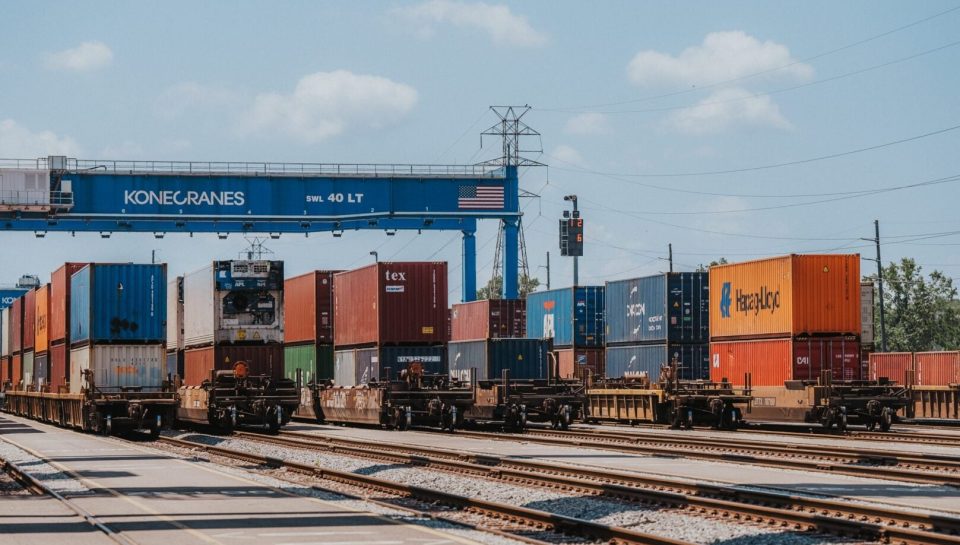
When a train is inbound to a major hub, it doesn’t simply pull up to a waiting crane and get unloaded. It enters a system that may already be under pressure. The strip tracks — where trains are actually unloaded — may be occupied by another train that arrived before yours. That train might be 8,000 feet long and take 12 hours to process. There may be three more trains waiting behind it.
It’s worth saying clearly: the vast majority of trains are processed efficiently and on schedule. Modern intermodal hubs are remarkably high-performing operations, and service reliability has improved significantly over the decades. But in a bunched service scenario — common after a weather event, a derailment, or any significant disruption that stops traffic and then releases it all at once — your container could be sitting in a support yard, on a railcar, a mile from the unloading crane, for 24 to 48 hours. The tracking system correctly shows the train as arrived. What it can’t show you is the queue.
Asking for a cherry pick or a hot deramp is harder than it sounds.
When freight is urgent, shippers often request a cherry pick, or hot deramp — pulling one specific container off a train before it’s been worked in sequence. It’s a reasonable ask. It’s also a significant operational event.
A cherry pick can mean locking out a track, clearing containers that are blocking access, repositioning a chassis, and rolling a crane to a specific location — all of which require coordination among a crane operator, a ground person, and a yard tractor driver. Three people, multiple moves, and a disruption to the production rhythm of a facility that may be processing thousands of containers that day. It can absolutely be done. But it has a cost to the overall operation, and it works best when it’s escalated clearly and early, not requested at the last minute through a general customer service line.
Your driver is lost. Here’s why.
Intermodal yards are large, specialized environments with their own geography and logic. A container notification might show a location like “T111” — trackside on track 111 — or a yard coordinate like “Lot 1, Row 1, Space 1.” To an experienced driver who knows the facility, that’s useful. To a driver visiting for the first time, it’s a puzzle with no map.
The shippers who move freight most efficiently through intermodal hubs are the ones who have invested time in understanding that geography — and have ensured their trucking partners do too. A facility tour, a conversation with hub personnel, a basic yard map shared with drivers — these are low-cost investments that pay off in faster turns, fewer calls, and more on-time deliveries.
The weekly rhythm nobody tells you about.
Here’s something that takes even experienced hub supervisors time to learn: intermodal terminals operate on a predictable weekly equipment cycle that looks like a crisis if you don’t know it’s coming.
Let’s break it down:
- Most shippers work Monday through Friday, so container arrivals really pile up at destination hubs over the weekends when gate activity is almost non-existent. By Tuesday mornings, there’s a serious strain on the chassis supply—sometimes it looks like there’s barely a chassis to be found.
- By the weekend, it’s the extreme opposite; it might seem like too many bare chassis are lying around, and things are out of control. But this is just how the flow works.
- Railcar supply operates in the inverse of chassis supply. You’ll see a surplus of railcars on Monday and Tuesday, but by Friday, they’re in short supply.
What the Best Shippers Do Differently
The shippers who navigate intermodal most successfully share a few habits. They build real relationships — with customer service teams, and where possible, with hub personnel directly. They escalate urgent freight early and clearly. They don’t wait for problems to compound before making a call.
Most importantly, they treat the terminal as a partner environment rather than a black box. They visit. They ask questions. They learn the names of the people who can help them.
The intermodal system, at its best, is an extraordinary logistics machine—efficient, high-capacity, and steadily improving. But it rewards those who understand it. The invisible walls aren’t permanent. Most of them dissolve the moment you know where to look.
James Johansson is a 30-year veteran of intermodal rail operations and former Director of Port Operations at the Ports of Los Angeles and Long Beach through BNSF Railway.
Photo Credit: Georgia Port Authority



