




By PraxiChain
Here’s What Shippers Need to Do Before April 30
The executive debate is loud. The shipper’s silence is louder. One of these is about to become a problem.
“If your competitor was doing something stupid, what would you do? You’d shut up and let them do it.”
– Jim Vena, Union Pacific CEO, MARS 2026
He was talking about the other Class I railroads — BNSF, CPKC — who have been the loudest critics of the proposed Union Pacific–Norfolk Southern merger. But reading the coverage since MARS, our team at PraxiChain keeps thinking about a different audience: the shippers who haven’t said anything yet.
That silence has a cost. And the clock is now running.
First, What’s Actually Happening
In December 2025, UP and NS filed a joint merger application with the Surface Transportation Board. The STB rejected it — not on the merits, but because it was incomplete. Regulators found the application was missing required full-system competitive impact analyses and forward-looking market share projections.
UP and NS have until June 22, 2026, to re-file. They’ve signaled April 30 as their target date.
That reset matters. It means the formal public comment period — the window when shippers, trade associations, and affected communities can put their concerns, data, and conditions on the record — hasn’t opened yet.
You still have time to prepare. But preparation requires more than knowing which services to call. It requires understanding what’s actually in the filing — and what your data says about your exposure.
What the Executive Noise Actually Means for You
At MARS in January, the gloves came off. Vena defended the deal’s customer benefits. CPKC CEO Keith Creel fired back, arguing that if 20% of traffic benefits, the other 80% of shippers should be asking hard questions about market power. BNSF CEO Katie Farmer also raised concerns about competitive harm.
One thing the executive debate makes clear: a 52,000-mile transcontinental network does not affect all shippers the same way. “One Network” sounds efficient — until you map it against your specific lanes, your interchange dependencies, and your contract structure.
Here’s how to read that debate if you’re a shipper:
- The “80% vs. 20%” argument is a signal, not a number. Creel’s framing is a regulatory strategy designed to prompt STB scrutiny of captive shippers and overlap corridors. Whether that applies to your traffic is something only your data can answer — not a general market assessment.
- Vena’s pitch is a comprehensive long-haul freight argument — and it’s getting more specific. In recent statements, Vena has framed the UP–NS deal as a structural solution to the inefficiencies of long-haul freight: fewer interchanges, faster coast-to-coast service, and the potential to attract freight currently moving by truck onto the combined network. He has also pushed back directly on critics who point to past merger failures, urging them to focus on what this transaction could deliver rather than on what prior consolidations got wrong. If you currently cross the UP–NS interchange gateway, those claims deserve lane-by-lane analysis, not a headline reaction.
- Vena’s support for reciprocal switching is significant — and unusual. In a notable departure from the standard Class I posture on competitive access, Vena has stated his support for reciprocal switching — adding that if UP fails to meet its service commitments, customers “should be able to go to somebody else.” For a Class I CEO, this is a highly unusual position. It may be a negotiating move designed to preempt STB-imposed conditions, or it may reflect genuine confidence in the combined network’s performance. Either way, shippers should take note: Vena is putting service accountability on the table. The question is whether that commitment ends up in the filing — and whether it’s enforceable.
- Service volatility is a real integration risk — but it is not uniform. Historically, post-merger integration has caused service disruptions in overlap corridors. The question is whether your lanes are in the disruption zone or the beneficiary zone. That answer lives in the filing, not in the press release.
- The STB rejection is an opportunity, not just a delay. A more complete re-filing means more data in the public record — more for shippers, trade groups, and intervenors to analyze, challenge, and build conditions around.
The railroads are building their case with precision. Shippers who engage with equal precision will have more leverage — in the STB proceeding, in contract negotiations, and in post-merger service discussions.
What Shippers Should Be Doing Before April 30
Our Rail Merger Advisory team works with shippers across agriculture, chemicals, energy, industrials, and intermodal. Across every sector, we see the same pattern: shippers who prepare before the comment window opens have meaningfully more leverage than those who engage after.
Here is the preparation framework we use with clients — whether they work with another advisor or with us.
1. Study the original filing. The December 2025 application — STB Docket FD 36873 — is publicly available and runs nearly 7,000 pages. You don’t need to read all of it. But you do need to read the sections covering your commodity, your corridors, and your current interchange points. Volume 1 covers public interest and competitive analysis. Volume 2 covers operating plans, service projections, and routing changes. Your traffic is in there. Find it before April 30.
2. Understand your specific exposure. Not every shipper faces the same risk or opportunity profile. The questions that matter most depend on your situation:
- Are you a captive shipper on one network who would gain — or lose — single-line access under the combined railroad?
- Are you in an overlap territory in the Midwest or Southeast where competitive options could narrow?
- Do you ship agricultural, chemical, energy, or industrial commodities on corridors where UP and NS both currently operate?
- Are you an intermodal customer with gateway pricing concerns under a merged network?
Your answers determine your posture in the STB proceeding — whether you’re a supporter, a neutral commenter, or an intervenor seeking protective conditions.
3. Connect with your trade association now. The National Grain and Feed Association went further than most shipper organizations, filing formal comments with the STB that urged UP to supplement its application with greater detail on how the transaction would enhance competition and deliver tangible benefits for agricultural shippers — going after the substance of the deal, not just its paperwork. Notably, more than 60 trade associations had already informed the STB of their concerns about the potential impact of a UP–NS merger before the December application was even filed. That coalition is only growing.
When the revised application is filed and the comment period opens, associations representing agriculture, chemicals, energy, automotive, and industrials will need to respond with specificity. They will be more effective if their members have already mapped their exposure and arrived with data, not just concerns.
If your trade association isn’t actively tracking this proceeding, ask why. And make sure they understand your company’s specific situation before they file.
4. Build your evidentiary record. Under STB rules, shippers who want to formally participate — filing comments, requesting conditions, or seeking evidentiary hearings — must file a notice of intent. But the notice is just the entry point.
The STB has broad authority to impose conditions, including gateway access protections, reciprocal switching requirements, service commitments, and pricing protections for captive shippers. Those conditions are imposed only if the record reflects shipper interests — with data, with specificity, with lane-level evidence.
The railroads have teams of lawyers and economists building their case. The comment record is your counterweight. A well-prepared evidentiary submission is worth far more than a late-stage objection.
A Note on Choosing Your Advisory Team
As this merger has gained attention, shippers are being approached by a range of consulting firms offering merger-related services. That’s appropriate — this is a complex proceeding, and good advisors add real value.
Our counsel: before you engage any advisor, make sure they can answer three questions specifically:
- What have they actually read? The original STB filing is nearly 7,000 pages. Advisors who can speak to the specific competitive analyses, operating assumptions, and market share methodologies in the application will serve you better than those working from summaries.
- Do they have STB proceeding experience? Filing comments, preparing evidentiary submissions, and navigating the Board’s procedural rules is specialized work. Ask for specific examples from prior major rail transactions?
- Can they speak specifically to your commodity and corridor? General merger risk frameworks are a starting point. What you need is an analysis that maps your actual traffic, your actual interchange dependencies, and your actual contract exposure against the specific routing and service changes proposed in the filing.
At PraxiChain, our Rail Merger Advisory practice brings together consultants with Class I operating backgrounds, STB proceeding experience, and deep commodity-specific knowledge across the sectors most affected by this transaction. Karen Burchfield leads this practice as our Rail Industry Expert and Sr. Project Lead, and has advised shippers through prior Class I consolidation events.
We believe the best client relationships start with education — which is why we share frameworks like this one publicly. When you’re ready to apply it to your specific situation, we’re ready to help.
The Bottom Line
The open window for shipper engagement is real, finite, and more powerful than most shippers realize. It closes the moment the STB accepts the refiling.
The Clock Restarts – Know. Plan. Act.
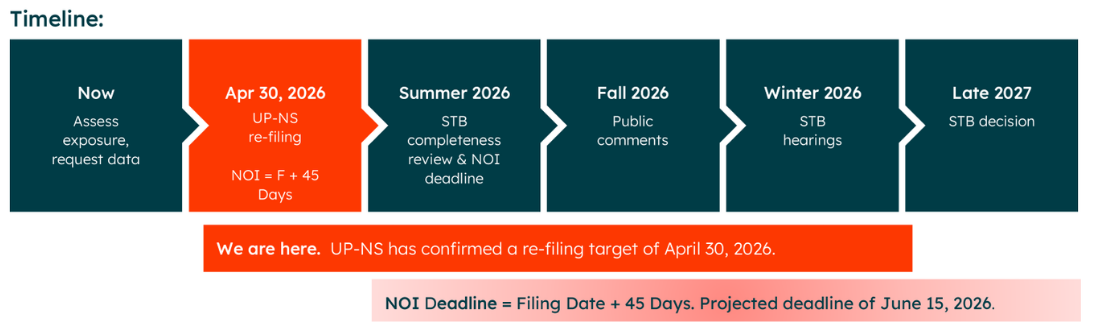
April 30 is not a deadline to react to. It is the open window — the moment when the formal record opens, and shipper voices carry real weight in a proceeding that will shape North American rail competition for a generation.
The railroads have spent months preparing a nearly 7,000-page application. The shippers who will be best positioned — in the STB proceeding, at the negotiating table, and in post-merger service discussions — are the ones who match that preparation with their own.
If you’re a shipper trying to understand what the UP–NS merger means for your supply chain, your rates, or your service options, now is the time to start. Not after the re-filing. Now.
About PraxiChain’s Rail Merger Advisory Practice
PraxiChain is a Chicago-based industrial supply chain and logistics consulting firm serving energy, agriculture, chemicals, industrials, transportation, and private equity clients. Our Rail Merger Advisory practice helps shippers, investors, and trade organizations understand the strategic and operational implications of major rail transactions — and navigate the STB process with precision.
Karen Burchfield, Rail Industry Expert & Sr. Project Lead at PraxiChain, brings a Class I railroad background spanning operations, commercial strategy, and regulatory proceedings. She translates complex STB filings into actionable shipper strategy and has guided clients through prior Class I consolidation events.
Ready to map your exposure? Contact us to learn more about our Rail Merger Advisory services.



